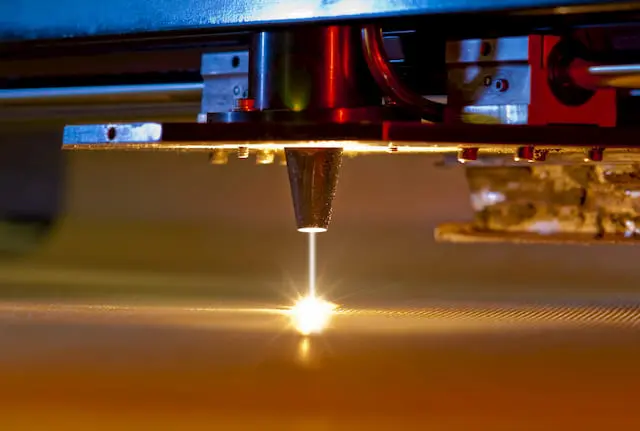
- Author jon_k /
- 0 comments /
- November 27, 2025
The history of laser cutting started more than a century ago
Laser cutting started quite a lot earlier than most people think. The connection between energy and the frequency of radiation was first identified as a possibility by Max Planck, with his theory being extended and improved by Albert Einstein in 1905. By 1917, Einstein announced the theory of stimulated emission. Although scientists were aware of the theory, almost 40 years passed before it was possible to prove the theory in a lab. Charles Hard Townes, Herbert J, Zeiger and James P. Gordon finally achieved this in 1945.

The original measurement of laser strength was referred to as ‘gillettes’ – a reference to the number of razor blades that a laser beam could cut through. While we like the idea of referring to the power of lasers as gillettes today, most lasers can cut through enough razor blades that the term stops making sense – so it is little wonder that the term was abandoned as lasers grew more powerful.
Although the word laser is widely used today, it is actually an acronym that stands for Light Amplification by Stimulated Emission of Radiation. The term was coined by Gordon Gould – who was a Columbia graduate student – in 1959.
The first carbon dioxide laser was developed in 1963 by Kumar Pael, which provided more power at lower cost compared with ruby laser technology. By 1967, CO2 lasers were being used alongside oxygen jet cutting to be able to cut through sheet steel of just 1mm thick. As technology developed, laser cutting began to be used in manufacturing. In 1970 The Being Company created multi-beam laser cutting technology, which allowed much harder materials such as titanium to be precision cut to create components.
3D laser cutting was first developed in 1979, and uses a five axes rotation system. Fibre laser cutters only emerged for commercial use since around 2008, but they are becoming one of the most popular types of laser cutter for businesses to invest in.
There are several types of laser cutters
Today there are several different types of laser cutters on the market, with thousands of individual models available to buy in each category. Not all laser cutters can cut all types of materials though – each type of laser cutter is best suited for cutting certain materials. The three most commonly used types of laser cutters are:
Gas lasers
CO2 lasers create a laser beam by electrically stimulating a carbon dioxide gas mixture. They create a beam with a wavelength of up to 10.6 micrometres, and are used on non-metallic materials and some types of plastics. They’re pretty efficient, and the beam quality is high, so this type of laser cutter are amongst the most commonly used. The downside is that they can’t be used with metal materials.
Gas laser cutters can be used with: Wood, acrylic, glass, paper, textiles, plastics, some types of foils & films, leather, stone
Crystal lasers
Crystal lasers are also a type of solid state laser. The most common type of crystal lasers are nd:YAG (neodymium-doped yttrium aluminium garnet) and nd:YVO (neodymium-doped yttrium ortho-vanadate) – you can see why they have shorter names!
These types of lasers create a beam that has a wavelength of 1.064 micrometres, the same as fibre lasers, but they can be used with both metal and non-metal materials. The downside to crystal lasers is that the pump diodes have to be replaced after 8,000-15,000 laser hours, and unfortunately they’re expensive to replaces. The crystal also has a much shorter life span than a fibre laser.
Crystal laser cutters can be used with: Metals, coated metals, plastics, and for some ceramics
Fibre lasers
These are a type of solid state laser. The beam is created using a seed laser that is amplified through glass fibres that are supplied with energy through pump diodes. Fibre lasers create a very small focal diameter, so the beam created is up to 100 times greater in intensity than gas lasers of the same power. These types of laser cutters can cut with metals and non-metals, as crystal lasers can, but they have a much longer working life – around 25,000 hours. The beam intensity is much higher than with gas laser cutters, and parts are much less expensive, although fibre lasers rarely require any maintenance.
Fibre laser cutters can be used with: Metals, coated metals, plastics.
Laser cutters can cut a wide range of materials
Laser cutters can cut a number of materials, with different types of laser cutters being suited to different materials.
- Metals
- Wood
- Paper and cardboard
- Plastics
- Glass (not all laser cutters – and glass tends to be etched, rather than cut. Always use care when cutting glass)
- Organic materials including stone and leather
These materials should never be cut with laser cutters
Although laser cutters are incredibly versatile and can cut many different types of materials, there are some that should never be cut with lasers. Once you’ve made a significant investment of buying a laser cutter machine, whether for your business or for personal use, you’ll want it to run well and provide as much value for money as possible, and to perform well for you for as long as possible.
Some materials don’t just cause problems for your laser cutter though – some materials, when cut with a laser can release gases that are pretty toxic to the human body, as well as harming your machine. Avoid cutting these materials to avoid causing damage to yourself, your staff, or your machine.
PVC, vinyl, and artificial leathers – these materials release chlorine gas when cut, which can absolutely ruin your machine. Optics can be affected by the gas, metal parts of the machine can be corroded, and the control system can be damaged. Thick polycarbonate – this material over 1mm doesn’t cut well with a laser, but the real danger is that it is likely to catch fire. It creates long thin trails of soot that will cause damage to your machine.
ABS – this one is a messy one! It doesn’t vaporise, and at best, it melts and leaves mess inside the machine. At worst, it catches fire. But all that is secondary to the fact that it releases hydrogen cyanide when it is cut – which is extremely poisonous and simply isn’t safe to work around.
HDPE (milk bottle plastic) – another messy material – it catches fire and melts all over the machine.
Polystyrene foam – another messy material. It catches fire and burns really quickly, and leaves melted deposits on the machine.
Polypropylene foam – similar to polystyrene, polypropylene catches fire really quickly. Not only that, as it melts, it drips. Those drips continue to burn and they set incredibly hard – basically it will completely ruin your machine. Don’t do it!
Epoxy – this is going to create a burnt mess that will ruin the inside of your laser cutter, but it will also release poisonous fumes that are going to cause serious issues for personnel.
Fibreglass – another one that is going to cause problems for you. Fibreglass is made of two materials that don’t cut with lasers – glass and epoxy resin. We’ve just mentioned the poisonous fumes that epoxy will release – so don’t try and cut fibreglass in your laser cutter either.
Coated carbon fibre – although thin carbon fibre mat can be cut by your laser cutter (albeit with some fraying) it isn’t a good idea when it is coated. In this form, it will release toxic fumes. Definitely not recommended.
Foodstuffs – while we understand the hilarity in telling your mates that you precision cut their pizza in the laser cutter, stick to your normal pizza cutter. Laser cutters aren’t designed for cutting food, and your team will cut materials that can be toxic in the laser cutter (think wood or acrylic smoke). If you want to cut food using a laser, it is better to have a dedicated laser cutter for food items.
Materials with sticky glue backing – any type of material that has sticky glue on it spells expensive trouble for your laser cutter. The glue vaporises, which will coat the lens. After the lens has been coated, it will cloud, heat and ultimately crack the lens, meaning it will need to be replaced.
Laser intensity determines the thickness of what can be cut
How thick a material that can be cut by a laser cutter depends on the intensity of the laser. Lower intensity lasers can cut through thinner materials, while higher powered laser cutters will be able to cut through metal bars.
Lasers tend to be measured by their power – in 1,000 watts, or kilowatts. The total energy emitted by the laser light every second is the power.
Focal length of a laser lens determines the quality of a cut
The focal length of a laser lens is essential to know, since it has a huge impact on the quality of the work a laser cutter can produce. Lenses that have a short focal length create small spot sizes and short depth focus, and so the shorter the focal length, the better the quality of the cut. A shorter focal length also results in a shorter cutting time – especially with thin metal sheets.
For thicker materials, a longer focal length is essential for high quality finishes at better speeds. Short focal length lasers give a beam that is too wide to ensure the material stays molten as it moves through to the other side, and there is too much taper on the edge, creating a lower quality cut.
Laser cutting is pretty safe – as long as you’re doing it correctly
For those who have never used a laser cutter, using a laser to cut something does sound like it could be dangerous! And used freehand, a laser could cause significant damage to whatever it was pointed at – it is hot concentrated light, after all. But it is for that reason that most laser cutters are fully enclosed systems that don’t allow the laser to operate unless the required safety doors and catches are closed properly, and they are controlled by computers that ensure the laser is pointed exactly where it needs to be.
Where laser cutters are fully enclosed and interlocked systems, they are usually considered low risk when they are used as they are designed to be. However, if safety features are bypassed, lasers can cause serious injuries to skin and eyes if the beam is exposed. Basically – as long as laser cutters are used properly, accidents are unlikely.
Of course, it should go without saying that all machinery should be used with care, and using suitable safety equipment and PPE. If you’re cutting materials that could emit dust or sharp swarf, safety glasses and gloves should be used, and hearing protection may be required too, although laser cutting is generally quiet. If an assist gas is being used, keeping the gas stored appropriately is essential to prevent accidents.