- Author jon_k /
- 0 comments /
- January 2, 2026
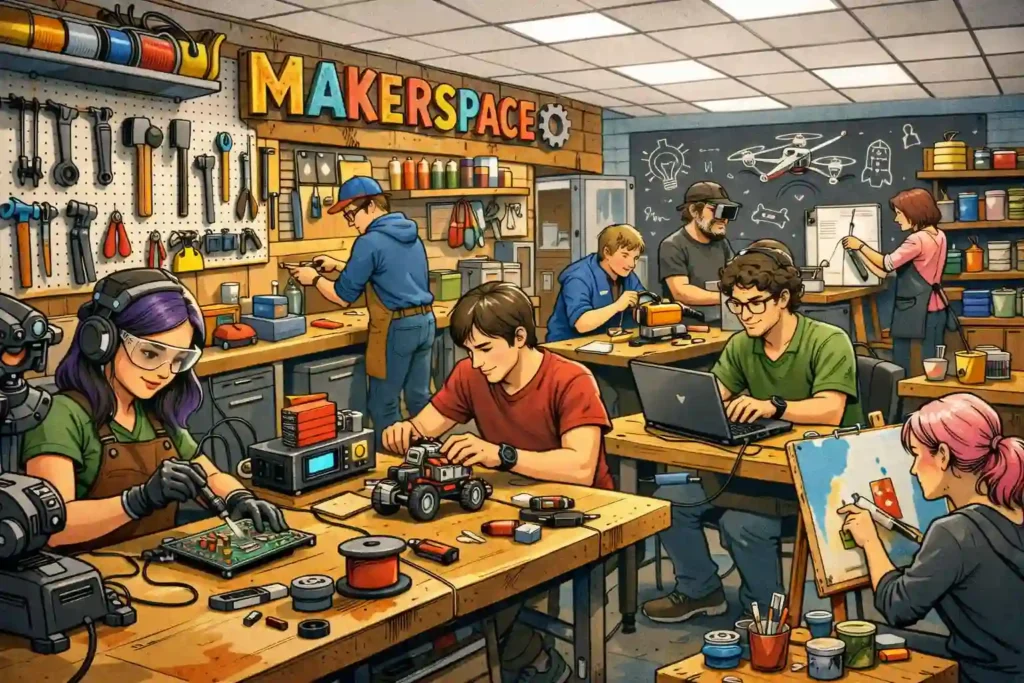
As the maker movement has matured, community-run and nonprofit makerspaces have emerged as critical access points for creative, technical, and entrepreneurial learning. While early makerspaces often comprise of crafters and hobbyists, late stage makerspaces emerge for a broader population like artists, educators, entrepreneurs, repairers, students, and lifelong learners — each using shared tools to solve real problems or pursue long-held goals.
Like the communities they serve, makerspaces take many forms. Some operate from dedicated facilities with full woodshops, metalworking equipment, and digital fabrication tools. Others rely on smaller footprints, mobile setups, or shared rooms that can be reconfigured for different programs. What unites them is not scale or budget, but a commitment to shared access: tools and knowledge made available to people who might otherwise lack both.
Beyond Hobbyist Making
Modern nonprofit makerspaces increasingly function as informal learning hubs and economic enablers. Equipment such as laser cutters, CNC machines, 3D printers, vinyl cutters, sewing and embroidery machines, and electronics workstations allow members to prototype ideas, create custom goods, repair equipment, or learn new skills without the overhead of owning specialized tools.
In many cases, the work done in these spaces is explicitly practical. Makers produce signage, replacement parts, accessibility tools, educational aids, and small-batch products. These outputs are not speculative; they address immediate community needs and reduce costs for individuals, organizations, and institutions alike.
Solving Local Problems with Local Tools
One of the most consistent strengths of nonprofit makerspaces is their responsiveness to locally identified needs. Members do not wait for commercial solutions when they can design and fabricate alternatives themselves.
Examples include producing custom assistive devices, fabricating replacement components for broken equipment, creating signage and organizational tools, or modifying everyday objects to better serve people with disabilities. These solutions are often produced at a fraction of commercial cost, but more importantly, they are adaptable, iterative, and informed by direct user feedback.
Makerspaces also support their own operations through internal making: repairing equipment, producing fixtures, maintaining tools, and fabricating improvements that would otherwise require external vendors. This reinforces sustainability while modeling practical problem-solving for members.
Personal Meaning and Long-Term Learning
Not all making is utilitarian. Community makerspaces regularly facilitate deeply personal projects that would be difficult or impossible elsewhere. Couples design custom wedding décor. Artists experiment with new media. Retirees return to ideas abandoned decades earlier, finally equipped with tools and time to complete them.
These projects matter because they anchor learning in personal history and motivation. A makerspace does not impose deadlines, grades, or commercial pressure. Participants set their own pace and goals, often rediscovering curiosity and confidence that formal education systems may have sidelined.
Informal Education Without Gatekeeping
Unlike academic labs or corporate innovation centers, nonprofit makerspaces typically operate on open or low-cost membership models. There are no prerequisite courses, no mandatory outcomes, and no penalties for experimentation or failure. This lowers psychological as well as financial barriers to participation.
Many spaces support self-guided learning through documentation, visual guides, workshops, and peer mentorship. Clear, accessible instructions reduce reliance on memory or prior experience and allow participants to return after long gaps without penalty. This approach benefits both members and staff by creating shared expectations and scalable learning pathways.
Engagement Through Visibility and Storytelling
Sustaining diverse participation requires more than equipment; it requires intentional community engagement. Successful makerspaces actively highlight member projects, share stories of use, and demonstrate what is possible with shared resources.
Showcases, newsletters, exhibitions, podcasts, and public events help demystify tools and invite new participants. Featuring real people and real projects shifts perception from “specialized workshop” to “community asset.” It also reinforces belonging by recognizing contributors as co-creators of the space’s identity.
Residency programs, collaborative art projects, and themed initiatives further strengthen these connections by tying making to cultural history, social issues, or shared values. When projects are publicly displayed or celebrated, they extend impact beyond the walls of the space itself.
Makerspaces as Community Infrastructure
The impact of a nonprofit makerspace cannot be measured solely by square footage or equipment lists. These spaces function as social infrastructure: places where skills circulate, trust forms, and collaboration emerges across age, background, and discipline.
By providing access to tools, time, and shared knowledge, makerspaces enable people to learn, create, repair, and connect. They support experimentation without punishment and ambition without exclusivity. In doing so, they reinforce the makerspace as a true “third space”—neither home nor workplace, but a shared environment where community is built through making.
For small, nonprofit makerspaces, this role is not incidental. It is foundational.
If you would like to donate to our mission or make an impact in the Kalamazoo Community contact us