- Author Ryan Rank /
- 0 comments /
- January 3, 2026
Most woodworkers approach dust collection backward. They buy machines first, then try to bolt on a collector afterward, hoping it will reduce cleanup and vaguely somehow “help with dust.” The result is usually a shop that looks cleaner but remains unsafe to breathe in.
Measured data tells a less comfortable story: dust collection is not about convenience, and it is not solved by owning a collector. It is an airflow-and-filtration system, and small decisions compound quickly into either protection or exposure.
Clean Floors Are Not the Goal
The visible debris—chips, curls, and shavings—are the least important part of the problem. The real hazard is fine dust below 10 microns, which remains airborne long after machines shut off and is small enough to lodge deep in the lungs.
A shop can look tidy while containing elevated concentrations of respirable particles. This disconnect explains why many woodworkers sincerely believe their setup is “working” when objective air-quality measurements show otherwise.
Single-Stage vs. Cyclone: What the Difference Actually Is
Single-stage collectors pull dust directly through the impeller and into a bag or canister. Heavy material drops into the lower bag; fine dust rises to the filter. This design is simple, affordable, and common—but it places enormous importance on filter quality and sealing.
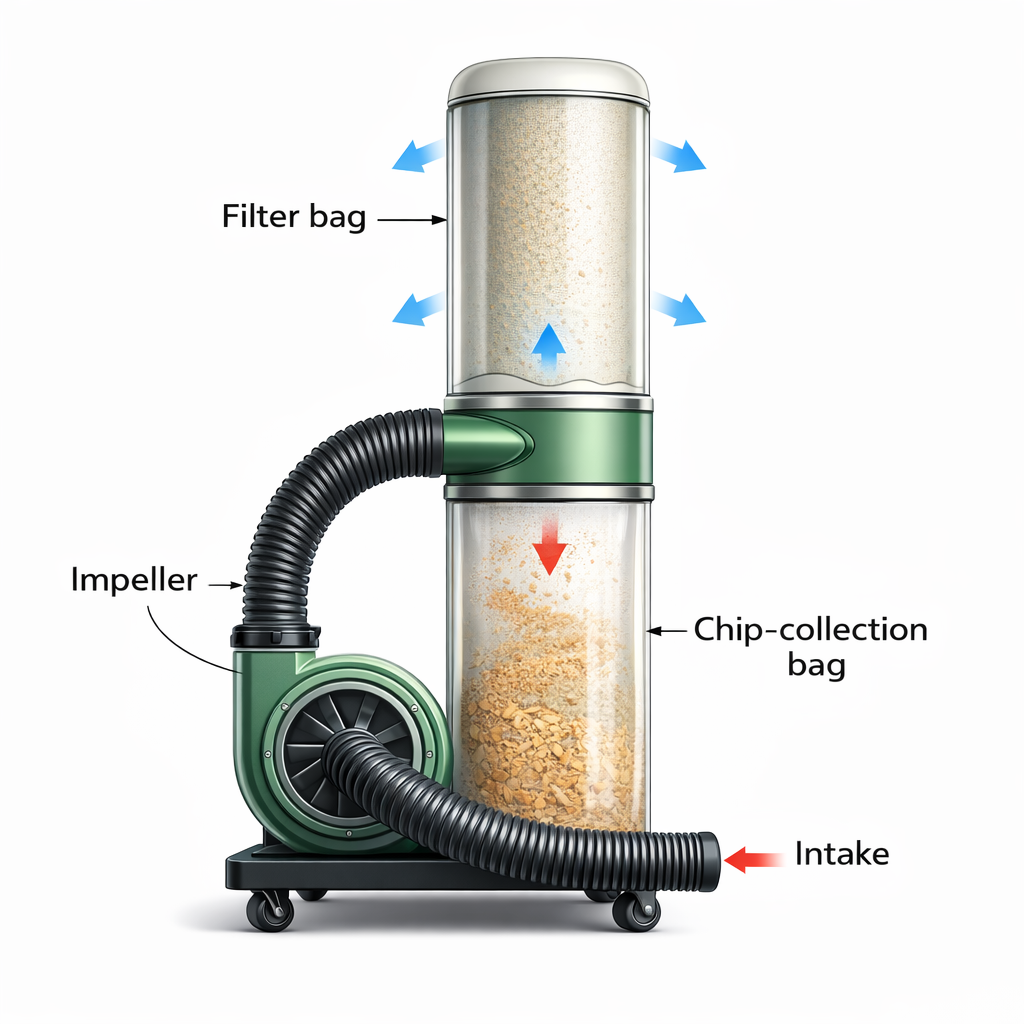
Two-stage cyclone collectors separate debris before it reaches the impeller. Heavier material drops out in the cone, while fine dust continues to the filter. The advantage is not just cleanliness; it is reduced filter loading and more stable airflow over time.
The key distinction is not “better” versus “worse,” but how quickly performance degrades as dust accumulates.

Airflow Is the Constraint Everyone Underestimates
Manufacturers advertise airflow in cubic feet per minute (CFM), but those numbers are often measured under ideal conditions with no resistance. Real shops introduce resistance immediately:
- Flex hose
- Elbows
- Reducers
- Wyes
- Long runs
Every added obstruction increases static pressure and reduces actual airflow at the tool. Independent testing shows that even short lengths of ribbed flex hose can cut delivered airflow to one-half or one-third of rated values.
As a rule of thumb, around 400 CFM is required to keep chips and dust suspended in ductwork. Lower airflow may function in very short runs, but performance collapses quickly as distance and bends increase.
This is why “it works fine on my planer” does not generalize to the rest of the shop.
Filters: Where Most Systems Quietly Fail
Getting dust to the collector is only half the system. What happens next determines whether you are cleaning the air or recirculating the hazard.
Most modern collectors claim filtration down to 1–2.5 microns, but real-world performance varies widely due to:
- Filter media type
- Surface area
- Dust cake behavior
- Leakage at seams, rims, and clamps
Testing with particulate meters shows that small leaks matter. Air escaping from seams or poorly sealed bag rims can release fine dust you cannot see but can measure—and inhale.
Counterintuitively, some bag filters outperform canisters for fine-dust containment, despite canisters often being marketed as “upgrades.” The reason is simple: airflow paths, sealing, and dust cake formation matter more than form factor.
Dust Cake: Necessary, but Not Free
As filters load with dust, they become better at trapping fine particles—but airflow drops. Cleaning the filter restores airflow but temporarily reduces filtration efficiency until a new dust cake forms.
This creates an unavoidable tradeoff:
- More airflow = more capture at the tool
- Better filtration = more resistance
There is no static “best” condition. Effective systems are maintained deliberately, not assumed to be self-correcting.
The Flex-Hose Problem
Flex hose is convenient and destructive to airflow.
Best practice is blunt:
- Use the shortest possible lengths
- Eliminate unnecessary bends
- Install blast gates so unused branches are closed
Planer chips, in particular, are prone to hanging up in flex hose, compounding pressure loss and increasing airborne release when blockages clear.
Flex hose should be treated as a temporary connector, not ductwork.
Why “It Meets the Standard” Is the Wrong Benchmark
Many collectors meet or exceed industrial regulatory limits. That sounds reassuring until you remember what those standards are designed for: minimum compliance, not best practice, and not long-term exposure in small enclosed shops.
Respiratory damage from wood dust is cumulative and slow. The absence of immediate symptoms is not evidence of safety.
The Real Hierarchy of Control
In order of effectiveness:
- Capture dust at the source with sufficient airflow
- Maintain fine filtration with verified sealing
- Use ambient air cleaners to reduce lingering dust
- Wear respiratory protection when risk remains
Skipping steps and relying on masks or cleanup after the fact is not a strategy—it is damage control.
Conclusion: Put Money Where the Dust Doesn’t Blow
Dust collection systems should be evaluated by two metrics only:
- How much air they actually move at the tool
- How little fine dust they return to the shop
Everything else—portability, remotes, convenience features—is secondary.
A collector that keeps your floor clean but your air dirty is not “good enough.” It is merely quieter about the damage it causes.